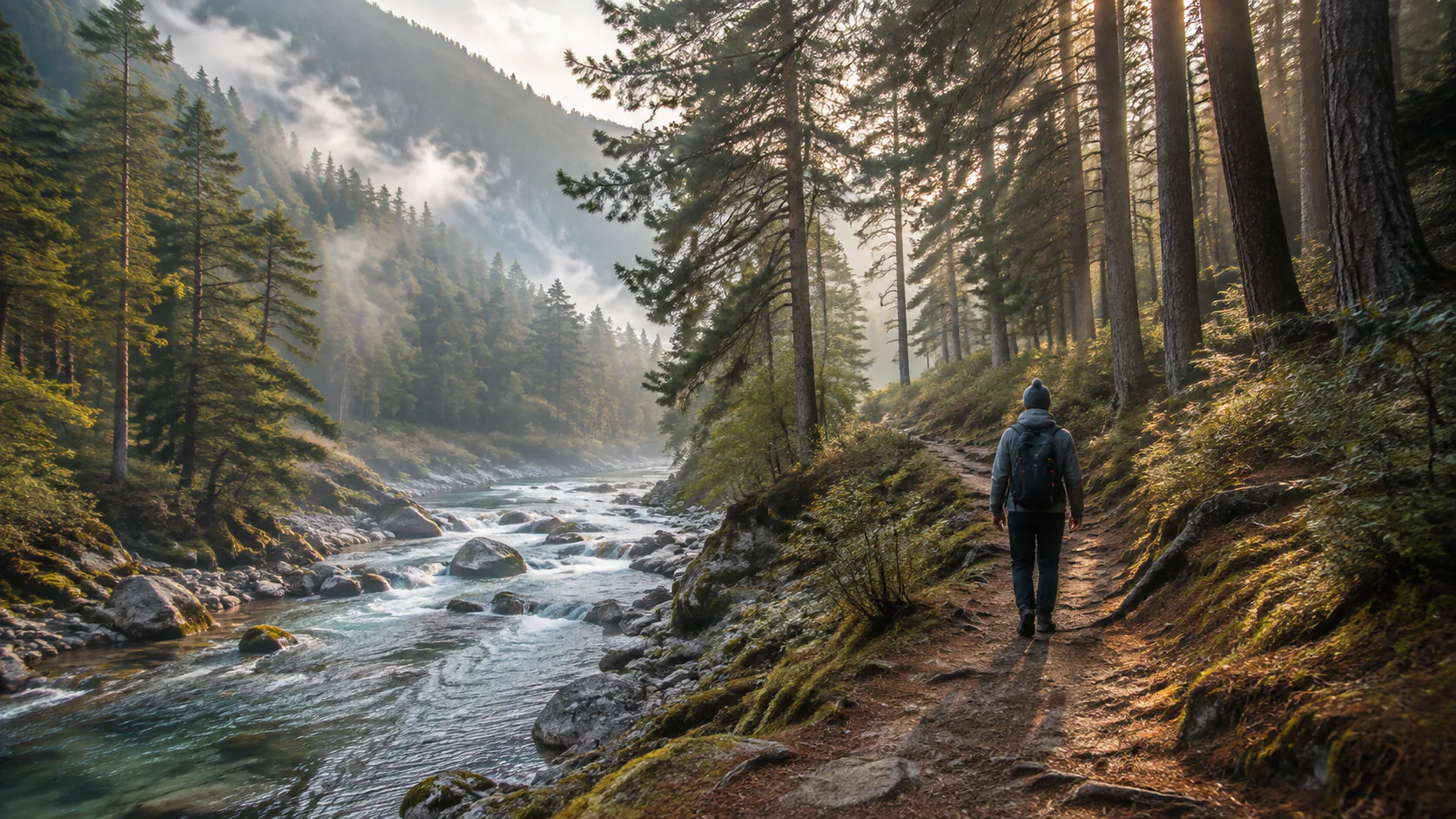
Bhutan’s landscapes invite a different kind of journey. Here, travelling does not always need to mean rushing between attractions. It can also mean slowing down beside a river, listening to wind move through the trees and noticing the mountain air with your full attention.
What is forest bathing?
Forest bathing is commonly associated with the Japanese practice of shinrin-yoku—immersing oneself in the atmosphere of a forest. It requires no water, special equipment or strenuous exercise.
Unlike hiking, its purpose is not to cover a particular distance or reach a summit. A session may include slow walking, stillness, natural breathing and invitations to notice sounds, textures, colours and movement. The experience is intentionally simple: less conversation, less urgency and greater awareness of the surroundings.
Why Bhutan is a natural setting for it
Bhutan has made environmental conservation part of its national identity. Its Constitution requires the country to maintain at least 60% forest cover for all time. Official Bhutanese sources report that forests currently cover more than 70% of the country.
That commitment is visible in forested mountains, agricultural valleys and waterways. In Paro, wooded slopes, fields, traditional settlements and the Paro Chhu create opportunities to experience nature without undertaking a demanding expedition. This makes forest immersion a natural part of a thoughtful Bhutan wellness retreat.
What a guided session may look like
A session usually begins by putting phones away and allowing the body to settle into a slower rhythm. The guide may invite participants to notice their breathing before walking quietly through an appropriate natural area.
- Listen for nearby and distant sounds.
- Notice different shades of green and changing light.
- Observe the movement of leaves, clouds or water.
- Pause beside the river or beneath the trees.
- Spend a few minutes sitting without conversation.
- Record observations in a personal journal.
The experience may conclude with herbal tea, gentle reflection or a short sharing circle. Guests can participate at their own comfort level, and personal space is respected.
A practice of attention—not a medical treatment
Research into forest bathing is growing. Systematic reviews suggest that time in forest environments may support relaxation and psychological wellbeing, while also noting variation in study quality and design. These findings should be understood as promising rather than as proof of a cure.
Forest bathing is a supportive wellbeing activity, not a replacement for medical or mental-health care. Its most immediate value may be the opportunity it creates: time away from screens, fewer demands on attention and permission to move without urgency.
Forest bathing at The Himalayan Reset
Nature is one of the seven connected wellness pillars of The Himalayan Reset: Nature, Movement, Mind, Nutrition, Sleep, Silence and Purpose. Slow walking supports gentle movement; sensory awareness encourages mindfulness; quiet time beside the river introduces silence; and journaling helps guests reflect on what they want to carry into daily life.
During the retreat, forest bathing may be combined with morning breathing, gentle yoga, riverside meditation, sound-based relaxation and a traditional Bhutanese hot-stone bath. Activities are invitational and may be adjusted for weather, local conditions and the group’s comfort.
Who can participate?
The practice is generally gentle and requires no previous meditation or hiking experience. Participants should nevertheless tell the retreat team about mobility limitations, allergies or relevant health considerations. Comfortable footwear, layered clothing and weather protection may be recommended.
Guests should follow their guide, remain on suitable paths and respect local communities, sacred areas and the natural environment.
Taking the practice home
The landscape may change after Bhutan, but the habit of paying attention can remain. Put the phone away for twenty minutes, walk more slowly than usual, notice one thing through each sense, pause somewhere safe and write down one observation before leaving.
Forest bathing does not ask travellers to achieve anything. It simply offers time to become present—beneath the trees, beside the river and between one unhurried breath and the next.
A responsible wellness note
This experience supports general wellbeing, relaxation and mindful living. It is not a substitute for medical diagnosis, treatment or professional mental-healthcare services.
Sources and further reading
This original article was informed by Bhutan’s National Biodiversity Centre, the Royal Bhutanese Embassy’s environmental overview, and peer-reviewed reviews indexed by PubMed and the International Journal of Environmental Research and Public Health.