A bow is raised. Breathing settles. Attention narrows to posture, direction and the distant target. For a beginner, archery can make concentration feel tangible—while offering a respectful introduction to one of Bhutan's most important living traditions.
Archery as a living Bhutanese tradition
Known locally as da, archery is Bhutan's national sport. Bhutan's official tourism authority describes its tournaments as lively and highly competitive occasions. This distinction matters: traditional Bhutanese archery should not be misrepresented as an inherently silent meditation practice. Community competitions can be energetic, social and celebratory.
For visitors, the responsible approach is to learn from Bhutanese instructors and guides rather than arrive with assumptions about what the activity represents. Traditional equipment and community customs exist alongside modern competitive forms of the sport.
What makes a beginner session mindful?
“Mindful archery” describes the way a retreat session may be approached—not a separate historical form of Bhutanese archery. The emphasis is on awareness and learning rather than winning.
Before taking a shot, a beginner must place the feet securely, hold the bow correctly, follow the instructor's safety directions, look towards one defined target, draw without unnecessary haste and observe the result without immediate self-criticism.
An arrow that misses can reveal something about stance, timing or direction. An arrow that lands well does not need to create pressure to repeat the result perfectly. The target provides feedback without becoming a measure of personal worth.
A guided archery experience in Paro
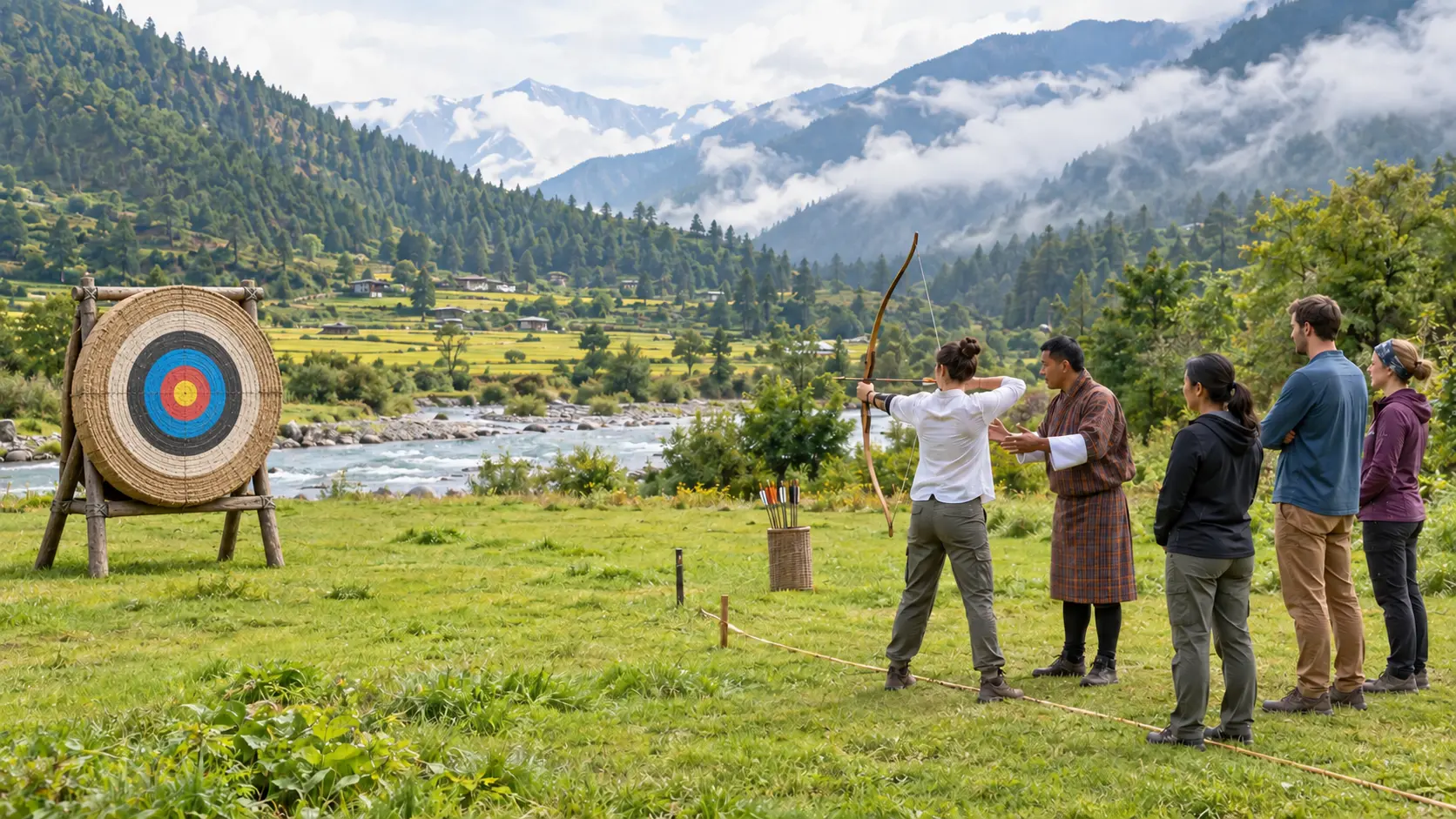
A beginner session during The Happiness Retreat may take place in an appropriate open area with a controlled range and safe separation from roads, buildings, animals and members of the public. It begins with an introduction from a qualified local instructor before guests handle any equipment.
The session may include an explanation of the bow, arrows and target; a clear safety briefing; gentle upper-body preparation; a demonstration of stance; supervised practice at a beginner-appropriate distance; and a closing conversation about the cultural experience.
Only the active participant approaches the shooting position. Everyone else remains behind the designated safety line, and arrows are collected only after the instructor confirms that the range is clear. The aim is not to reproduce a full Bhutanese tournament, but to offer a safe and respectful introduction.
Focus on the process, not the score
Modern life often rewards immediate outcomes. Archery introduces another possibility: complete the process carefully, release the result and learn from what happened.
A guest may discover that trying too hard makes the body tense, or that attention wanders towards another participant's result. The instructor can bring attention back to the next manageable action: reset the feet, soften unnecessary tension, look towards the target and follow the agreed sequence.
This is not a treatment for stress, anxiety or any medical condition. It is an experiential way to practise patience and focused attention.
Movement without a fitness competition
Archery involves posture, coordination and controlled movement, but a retreat introduction is not an intensive workout. Equipment, shooting distance and the number of attempts should be adapted to each guest's comfort and ability.
Participants should tell the retreat team about shoulder, back, wrist or mobility concerns before the session. Anyone with an injury or medical restriction should follow advice from a qualified healthcare professional. Guests may always observe instead of shooting; cultural participation does not require physical participation.
Learning with cultural respect
A Bhutanese archery experience should be led by local knowledge. A Bhutanese guide or instructor can explain the sport's place in daily life, differences between traditional and modern competition, appropriate behaviour around a shooting ground, and when photography is acceptable.
If guests observe an actual community competition, they should remember that it is first a local event—not a staged tourism performance. Traditional clothing, celebratory gestures and social customs should not be copied without context or treated as photographic props.
Archery and the Seven Pillars
The Himalayan Reset is shaped by Nature, Movement, Mind, Nutrition, Sleep, Silence and Purpose. A guided archery experience can connect several of these pillars.
Movement appears through stance and controlled physical action. Mind is engaged through patience and the ability to begin again after an imperfect attempt. Nature forms the setting within Paro's open landscape. Purpose enters through a simple question: what deserves our attention, and what distracts us from it?
Brief quiet may help a participant prepare to shoot, but the experience does not erase archery's lively Bhutanese character. It becomes one cultural element within The Happiness Retreat, not a separate programme or promise of transformation.
Safety comes before the photograph
Archery equipment must always be treated responsibly. A safe session requires suitable equipment, an experienced instructor and a properly controlled range. Participants must never point a bow or loaded arrow away from the designated target.
The session should stop if weather, visibility, equipment or surrounding activity makes shooting unsafe. Alcohol must never be combined with participation. Photographs should wait until the instructor confirms they can be taken safely; nobody should cross the safety line or distract the archer for a better image.
Taking the lesson home
The bow and arrow remain in Bhutan, but the underlying process can travel. Pause before beginning, establish a steady foundation, choose one clear target, remove avoidable distractions, complete the action without rushing, observe the result honestly and adjust before trying again.
The aim is not perfection. It is learning to give one chosen action complete attention.
A different way to encounter Bhutan
Bhutanese archery is lively, skilful and culturally significant. During The Happiness Retreat, a carefully supervised introduction can provide a memorable meeting point between cultural discovery and personal attention.
Guests may not hit the centre of the target. That is not the measure of the experience. The meaningful part may be the moment before the arrow is released: feet grounded, eyes directed forward and attention no longer divided.
A responsible wellness note
The Himalayan Reset offers cultural and general-wellbeing experiences. Archery and mindfulness activities do not diagnose, treat, cure or prevent medical conditions and are not substitutes for professional healthcare.
Source and further reading
This original article was informed by the Bhutan Department of Tourism's official overview, which identifies archery as Bhutan's national sport and describes its lively competitive tradition.