Creativity often disappears beneath meetings, messages and tasks with measurable outcomes. Bhutan offers another rhythm: one shaped by skilled hands, natural materials and traditions carried carefully from one generation to the next.
What is zorig chusum?
Zorig chusum is commonly translated as the thirteen traditional arts and crafts of Bhutan. These disciplines include painting, sculpting, traditional paper-making, calligraphy, carving, casting, embroidery, woodturning, carpentry, masonry, bamboo and cane work, gold- and silversmithing, and weaving.
They are not interchangeable recreational crafts. Each carries specialised techniques, vocabulary, purposes and cultural meanings. Some works are closely associated with Bhutanese Buddhist practice, while others serve architectural, domestic or ceremonial functions.
Bhutan's official tourism authority explains that these protected traditions have been passed down through generations and remain visible everywhere from modest homes to important dzongs.
Traditional arts in contemporary Bhutan
Bhutan's creative heritage is not confined to museums. Painted motifs decorate buildings, intricate textiles are worn during daily life and important occasions, and craftspeople continue to produce practical and ceremonial objects.
The National Institute for Zorig Chusum in Thimphu, founded in 1971, trains young Bhutanese craftspeople in these traditions. Visitors can observe students learning and creating original work. A tradition remains alive when its skills are taught, practised and adapted—not merely displayed as something belonging to the past.
Responsible travellers can support this living heritage by learning from qualified local practitioners, purchasing authentic work through reputable sources and avoiding objects whose origin or cultural appropriateness is uncertain.
Why making something slowly feels different
Many modern activities reward speed. Traditional craft follows another rhythm. A pattern must be studied, materials prepared and unfamiliar movements practised. Mistakes cannot always be erased immediately; progress is gradual and visible.
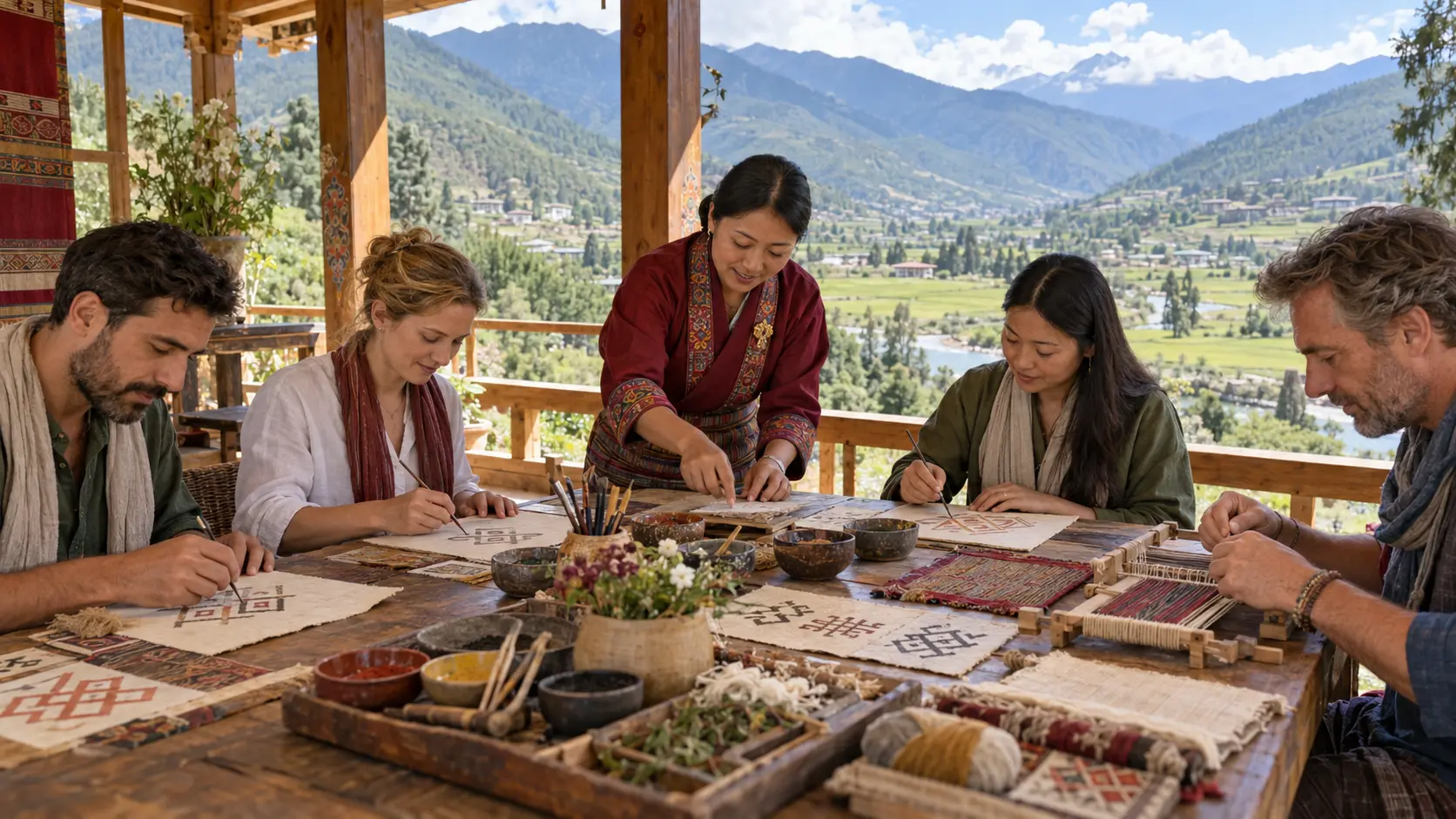
During a carefully facilitated creative session, guests may observe an artisan before beginning, put phones away, notice the texture of paper or thread, practise a simple technique and allow imperfections to remain part of the experience.
The objective is not to reproduce sacred imagery or become proficient in an afternoon. It is to experience sustained attention and develop greater appreciation for the knowledge behind the finished object.
A cultural experience grounded in respect
Bhutanese religious images, symbols and objects may carry meanings that are not immediately apparent to visitors. Certain designs follow established proportions or iconographic rules, while some objects are intended for devotional or ceremonial use rather than casual decoration.
A responsible workshop should be led or approved by an appropriate Bhutanese artist or cultural practitioner. The facilitator can explain what guests may create, which materials and motifs are suitable, and how finished work should be treated.
- Listen before attempting a technique.
- Ask permission before photographing an artisan or sacred work.
- Avoid claiming to have mastered a traditional art.
- Credit the artist and tradition when sharing photographs.
- Pay a fair price for original work.
- Check whether an item may legally and appropriately leave Bhutan.
What a mindful creative session may include
A retreat-based session does not need to reproduce formal vocational training. It may begin with an introduction from a Bhutanese practitioner, followed by a demonstration of materials and technique.
Guests might undertake a simple, culturally appropriate activity using handmade paper, colour and pattern, basic decorative strokes or a small weaving exercise. A quiet room overlooking the Paro Valley, a riverside table or a sheltered outdoor space can help attention settle.
There is no competition and no requirement to produce something impressive. Guests may keep their work private, share it with the group or leave it unfinished. The value lies in participation, not perfection.
Connecting creativity with the Seven Pillars
Mindful creativity connects naturally with the Seven Pillars of The Himalayan Reset. Nature inspires observation through colour and materials. Fine hand movements create bodily awareness. Mind is engaged by concentrating on one process, while periods of working without conversation complement intentional silence.
An unhurried Bhutanese meal after the workshop can continue the day's slower rhythm, and a quiet evening activity can replace stimulating digital distractions. Purpose enters through reflection on patience, learning and what deserves our attention.
These connections belong within a general Bhutan wellness retreat. They are not treatments for stress, anxiety, depression or any medical condition.
Creativity without performance pressure
Some adults arrive carrying an old belief: “I am not artistic.” A mindful session asks only for curiosity and willingness to participate.
Traditional artisans develop their skills through sustained learning, so a visitor's first attempt is naturally different from an experienced craftsperson's work. Instead of asking whether the result is good, guests can notice when their attention settled, how they responded to mistakes and what the artisan's patience taught them.
Taking mindful creativity home
Guests do not need Bhutanese materials or sacred motifs to continue the practice. They can write by hand, sketch an everyday object, mend clothing, arrange flowers, cook without screens or learn directly from an artisan in their own community.
The principle is simple: choose an activity involving the senses, put the phone away and allow the process to take the time it requires.
A more attentive way to meet Bhutan
Bhutan's traditional arts reveal culture through materials, patterns, buildings, clothing and knowledge passed between generations. A painted wall becomes evidence of disciplined technique; a woven textile carries hours of skilled work; handmade paper becomes part of a continuing cultural story.
Mindful creativity offers another way to slow down in Bhutan. The aim is not to leave as an expert. It is to return home with greater respect for craftsmanship—and perhaps a renewed willingness to do one meaningful thing at a time.
A responsible wellness note
The Himalayan Reset provides cultural, lifestyle and general-wellbeing experiences. Creative and mindfulness activities do not diagnose, treat, cure or prevent medical or mental-health conditions and are not substitutes for professional care.
Sources and further reading
This original article was informed by the Bhutan Department of Tourism's official introduction to Bhutan's culture and its guide to Bhutanese art experiences and zorig chusum.