
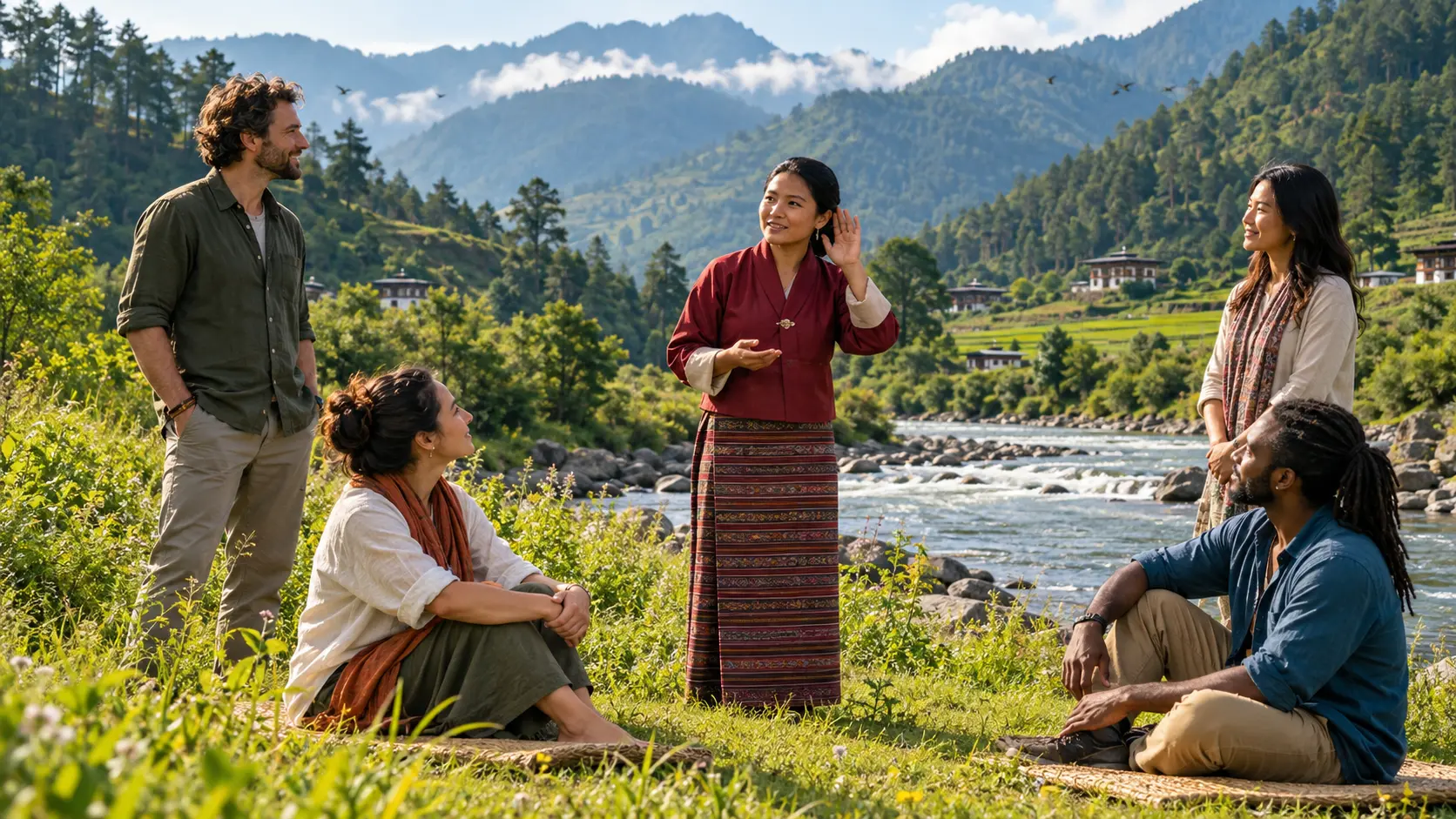
We rarely experience a place through listening alone. Modern journeys are largely visual: travellers photograph mountains, record videos and check maps while moving between destinations. Bhutan invites another form of attention.
Beside the Paro Chhu, the surrounding soundscape may include moving water, birds, wind through trees, footsteps across stone and the distant activity of the valley. None of these sounds needs to be recorded, analysed or turned into a performance. Mindful listening simply asks us to pause and notice what is already present.
What is a natural soundscape?
A soundscape is the complete acoustic environment experienced in a particular place. In a Himalayan valley, its layers may include flowing water, wind, birds, insects, rain, distant voices, bells, footsteps and ordinary village activity.
A natural soundscape does not mean absolute silence. Nature itself is full of movement and sound. The objective is not to classify every sound as pleasant or unpleasant, but to recognise the environment as it is and notice how attention responds.
Why Bhutan is suited to attentive listening
Bhutan’s official tourism authority describes the country as more than 70% forested and presents its landscapes and slower journeys as creating space for quiet awe. Paro offers an especially varied setting: the river moves through a cultivated valley surrounded by forested slopes, traditional buildings and mountain terrain.
Listening here is not about pretending Bhutan has no modern noise. Paro has an airport, roads, communities and active daily life. Its value lies in contrast—becoming aware of how water, wind, birds and human activity combine to give the valley its distinctive character.
Listening is different from hearing
Hearing generally happens without deliberate effort. Listening involves directing attention. A facilitator may invite guests to notice the closest sound, the most distant sound, a continuous sound, one that begins and ends, and the spaces between noticeable sounds.
No special interpretation is required. The sound of the river does not have to symbolise anything, and participants do not need to achieve a completely calm mind. The practice is simply an exercise in becoming more present to the surrounding environment.
What research suggests about natural sounds
A 2021 systematic review and meta-analysis covering 36 publications found associations between exposure to natural sounds and positive affect, reduced annoyance and other wellbeing-related measures. Water sounds showed strong average effects in some comparisons, although the studies varied in design, setting and measured outcomes.
These findings do not mean listening to a river will treat anxiety, high blood pressure, pain, insomnia or another health condition. The appropriate conclusion is modest: natural sounds may contribute to an environment that some people find pleasant or restorative.
Natural sound is not sound therapy
A riverside listening session does not diagnose or treat physical or mental-health conditions. It requires no gongs, singing bowls, recorded frequencies or claims about “healing vibrations.” Mindful listening begins with sounds already present in the landscape.
Sound-based relaxation may be offered separately by an appropriately trained practitioner. At The Himalayan Reset, any sound activity is presented transparently as a general relaxation or cultural-wellbeing experience—not as medical treatment.
What a riverside listening session may look like
A session may begin beside the river or in another location selected for safety, accessibility and minimal disturbance. Guests put away phones and remove headphones. Practical communication remains welcome and nobody is required to close their eyes.
Arriving
Participants notice posture, temperature and the physical sensation of standing or sitting.
Expanding attention
Rather than concentrating immediately on one sound, guests allow the full soundscape to become apparent.
Finding layers
Attention moves from nearby sounds to more distant ones—from footsteps and clothing to water, birds, wind and valley activity.
Listening while walking
The group takes a slow, short walk and notices how the acoustic environment changes with location.
Reflecting
Guests may write down three sounds they noticed and one detail they would normally have overlooked. Participation remains invitational.
Choosing the location responsibly
A peaceful photograph does not automatically indicate a safe listening location. River levels, slippery stones, weather, traffic, private property and local activity must be considered. Guests should remain on appropriate paths or stable designated areas and follow their guide.
- Do not block access used by residents.
- Do not disturb wildlife to obtain a recording.
- Remain safely away from fast-moving water.
- Never close the eyes near uneven ground.
- Do not record people without permission.
- Treat sacred and community spaces respectfully.
Listening without judging every sound
A dog may bark, a vehicle may pass, people may talk nearby and rain may become loud. Mindful listening does not require guests to label every sound relaxing. Instead, they can notice the difference between the sound itself and their reaction to it.
There is no correct response. Curiosity is more important than forcing a particular feeling.
Protecting hearing and personal comfort
The World Health Organization identifies transport, construction and amplified leisure sound as important sources of environmental-noise exposure. The retreat team should avoid hazardous noise and never encourage prolonged exposure to loud bells, machinery or amplified sound.
Guests with tinnitus, migraines, sensory sensitivities or hearing devices should tell the facilitator beforehand. They may move away, use suitable hearing protection, keep the session brief, choose another activity or leave without embarrassment.
Mindful listening and the Seven Pillars
Mindful listening connects naturally with several pillars of The Himalayan Reset. Nature provides the soundscape. Mind is engaged through deliberate attention. Silence appears not as the absence of sound, but as a temporary reduction in unnecessary conversation and digital stimulation.
A slow listening walk adds gentle Movement, while journaling can support reflection on Purpose. The practice complements forest bathing in Bhutan and differs from intentional silence, which focuses more broadly on pausing conversation and digital input.
Together these activities form part of a wider Bhutan wellness retreat, not a collection of promised cures.
Taking the practice home
- Choose a safe place without dangerously loud noise.
- Put the phone away and remove headphones.
- Notice the nearest sound.
- Gradually listen farther away.
- Identify one continuous and one changing sound.
- Notice reactions without forcing them to disappear.
- Write down three observations.
A garden, balcony, park or quiet room can become a place to listen with greater attention.
Hearing Bhutan differently
Bhutan is often introduced through mountains, monasteries, forests and architecture. Yet every landscape also has an acoustic identity. In Paro, the river, wind, birds, rain and ordinary life create a soundscape that cannot be fully captured in a photograph.
Sometimes a reset begins with looking up from the screen. At other times, it begins by removing the headphones and listening.
A responsible wellness note
The Himalayan Reset offers cultural, lifestyle and general-wellbeing experiences. Mindful listening and sound-based relaxation do not diagnose, treat, cure or prevent medical or mental-health conditions and are not substitutes for professional healthcare.
Sources and further reading
This original article was informed by the Bhutan Department of Tourism, the 2021 PNAS systematic review of natural sounds, and the World Health Organization’s environmental-noise guidance.