
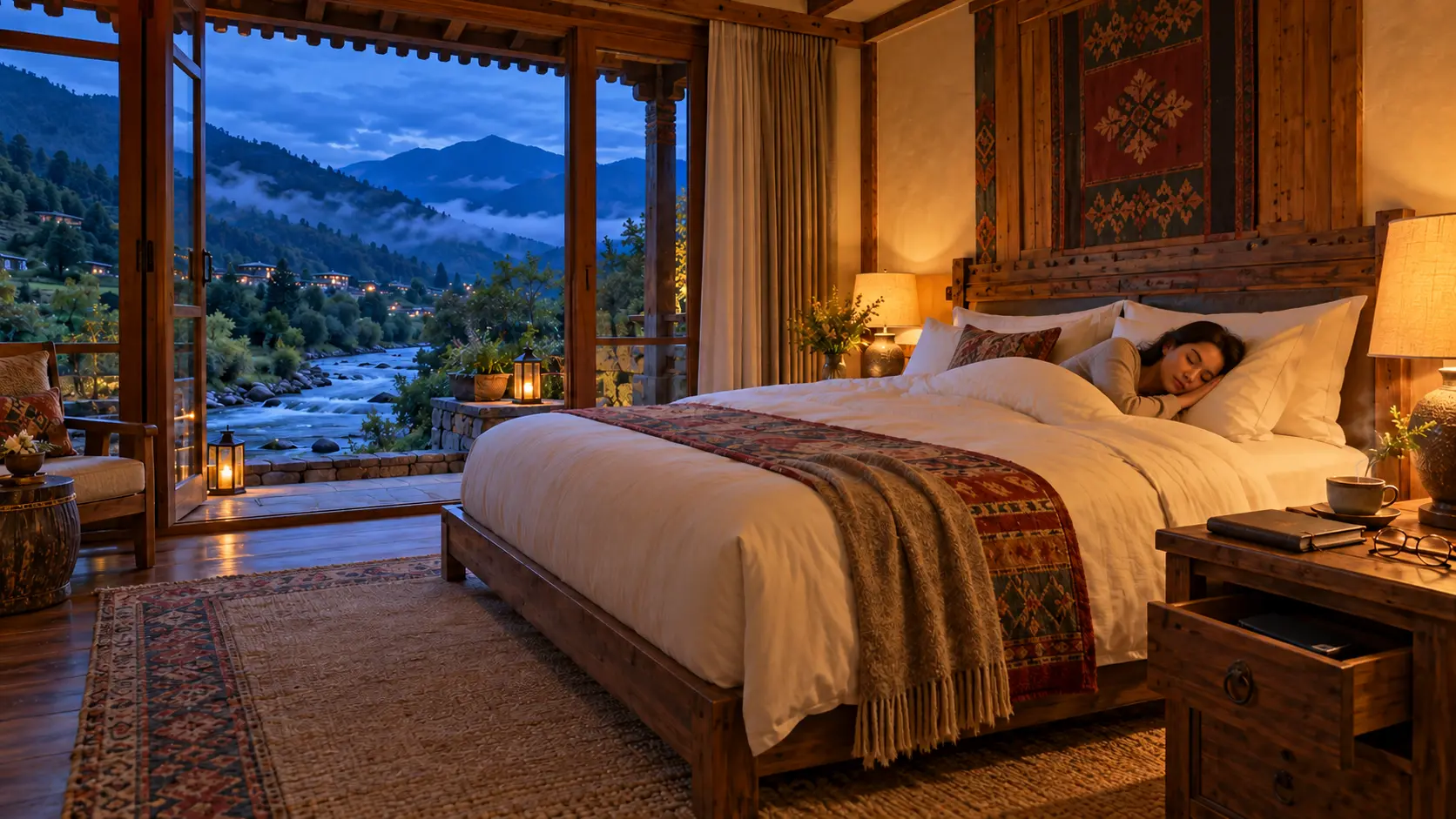
We often treat sleep as the empty space between two busy days. A wellness retreat offers an opportunity to approach the evening differently—with fewer demands, gentler routines and enough time for the day to reach a natural conclusion.
Why sleep belongs within a wellness retreat
Rest is not simply the absence of scheduled activity. It needs space within the programme. When every hour is filled with workshops, sightseeing and wellness sessions, guests may return to their rooms mentally stimulated rather than ready to settle.
A balanced retreat protects quieter periods between activities. It allows an energetic cultural experience, walk or excursion to be followed by unstructured time. The objective is not to make every guest fall asleep at the same hour, but to create conditions in which the body and mind are not continually being asked to perform.
Bhutan as a setting for slower evenings
Bhutan's official tourism website presents the country as a place where wilderness, wellbeing, meditation and traditional experiences coexist. It describes more than 70% of Bhutan as forested and highlights the contrast between active adventures and restorative experiences such as meditation and hot-stone bathing.
In Paro, evenings may be shaped by the river, forested hillsides, cultivated fields and changing mountain light. These surroundings do not automatically produce better sleep. Their value lies in what they make possible: an evening that does not have to be filled with shopping, traffic, nightlife or constant digital entertainment.
What a restful retreat evening may include
A sleep-supportive evening does not require an elaborate ritual. It might mean finishing demanding activities earlier, eating dinner without rushing, keeping lighting softer after the meal, putting work messages aside, taking a gentle riverside walk, writing briefly in a journal or reading a physical book.
The routine remains flexible. Some guests may prefer private time, while others settle more comfortably after quiet conversation. The useful element is consistency: the evening begins to follow a recognisable sequence rather than continuing at the same pace as the day.
Creating distance from evening screens
Phones are useful for communication, photographs, translation and travel arrangements. A sleep-conscious retreat does not need to portray technology as harmful or demand complete disconnection. Guests can instead be invited to create a screen-free period before bed.
The US Centers for Disease Control and Prevention includes turning off electronic devices at least 30 minutes before bedtime among its practical sleep recommendations. The National Heart, Lung, and Blood Institute also recommends using the hour before bed for quiet time and reducing bright artificial light from televisions and computer screens.
During The Happiness Retreat, this may mean checking essential messages at a designated time, activating “Do Not Disturb,” charging the phone away from the bed and replacing scrolling with reading or journaling. Guests who require a device for accessibility, healthcare or urgent communication should continue using it as needed. This flexible approach connects Sleep with the retreat's practice of digital quiet.
The role of light and darkness
Light is an important environmental cue in the sleep–wake cycle. NHLBI explains that light, darkness and other signals influence when people feel awake or drowsy, while artificial light can provide an unwanted wakefulness cue.
A retreat can respond without turning the evening into a clinical programme. Daytime activities may include natural outdoor light through walks, archery, forest experiences or time beside the river. Later, bedroom and common-area lighting can become warmer and softer. Curtains, comfortable room temperature and reduced unnecessary noise can help the sleeping environment feel calmer.
Evening food without restrictive rules
A retreat meal should feel nourishing and enjoyable, not medically prescribed. Very heavy late-night meals can make some people uncomfortable. NHLBI advises avoiding large meals and alcohol close to bedtime, while acknowledging that a light snack may be appropriate when needed.
At The Himalayan Reset, evening meals can support a gentler transition through a reasonable dinner time, unhurried portions, clear ingredient information and consideration of disclosed dietary requirements. Guests with diabetes, food allergies, prescribed diets or other medical needs should continue following professional advice. This approach complements mindful eating in Bhutan without labelling foods as universally good or bad.
Can a Bhutanese hot-stone bath be part of the evening?
The traditional Bhutanese hot-stone bath is one of the country's distinctive cultural wellness experiences. River stones are heated and used to warm water in a wooden bathing arrangement, sometimes with locally used herbs. Bhutan's tourism authority presents hot-stone bathing as part of the country's broader wellbeing tradition and as an experience people use to decompress.
During a retreat, it may be offered as an optional cultural relaxation experience—not as a sleep treatment. Heat is not suitable for everyone. Guests who are pregnant or have cardiovascular, blood-pressure, heat-sensitivity or other relevant medical concerns should seek appropriate professional advice before participating. Learn more in our guide to the traditional Bhutanese hot-stone bath.
Quiet without forced silence
A restful evening does not have to become a formal silent retreat. Some guests enjoy complete quiet; others feel more settled after talking with fellow participants, calling family or sharing tea.
The programme may introduce a quieter period after dinner while still allowing guests to communicate practical needs. Notifications and loud group activity can be reduced without imposing silence on everyone. This connects the Sleep pillar with intentional silence in Bhutan while respecting individual comfort.
Sleep should never become another performance goal
Wellness programmes can turn rest into another achievement to measure. Guests begin counting minutes, judging every awakening or worrying that they are failing if they do not sleep perfectly. That pressure is unnecessary.
Travel, unfamiliar surroundings and changes in routine can all influence sleep. One difficult night does not invalidate a retreat experience. The Himalayan Reset does not promise a particular number of sleeping hours or guaranteed improvement. Its role is to provide a considered environment and practical opportunities for guests to observe their routines.
Anyone experiencing persistent insomnia, breathing interruptions during sleep, severe daytime sleepiness or another sleep-related concern should consult an appropriately qualified healthcare professional.
Sleep within the Seven Pillars
Sleep does not stand separately from the other pillars. Nature provides outdoor light and a gentler sensory environment. Movement creates opportunities for appropriately paced daytime activity. Mind helps guests notice habits without immediate judgement. Nutrition considers the timing and character of evening meals. Silence reduces unnecessary stimulation, while Purpose helps guests decide which evening boundaries genuinely matter.
Together, these pillars form the wider rhythm of The Happiness Retreat, a premium seven-night Bhutan wellness retreat in Paro.
Taking a restful routine home
The most useful practice is one that survives ordinary life. A simple transition may involve finishing essential messages, putting the phone on “Do Not Disturb,” lowering unnecessary lighting, preparing for the following morning and spending a little time reading or journaling.
The landscape at home may be different, but the sequence can remain. A sustainable routine is more valuable than an ambitious ritual that disappears after a few days.
Letting the day end
Bhutan's mountains and rivers create a memorable setting, but the deeper lesson may be simpler: every day needs a conclusion. The phone becomes quiet, the programme pauses and guests are no longer required to achieve, respond or move towards the next activity.
Nothing guarantees perfect sleep. Yet creating a respectful boundary between the day and night can be a meaningful part of learning how to rest.
A responsible wellness note
The Himalayan Reset provides general wellbeing and personal-enrichment experiences. Its sleep-supportive activities do not diagnose, treat or cure insomnia, sleep apnoea or any other medical condition and are not substitutes for professional healthcare.
Sources and further reading
This original article was informed by the Bhutan Department of Tourism, its guidance on wellness and wellbeing, the CDC's sleep guidance, and the US National Heart, Lung, and Blood Institute's healthy-sleep guidance.